Spinal Osteoporosis
Osteoporosis often progresses silently without pain or obvious symptoms, and it is common for people to discover they have the disease only when they unexpectedly suffer a fracture one day. A minor fall can result in fractures of the wrist, hip, or spine. In particular, hip fractures and spinal fractures cause severe pain and require prolonged bed rest. Hip fractures have a reported mortality rate of up to 20% within one year. Because osteoporosis typically shows no distinctive features in its early stages and is considered a disease of old age, many younger people neglect to take care of their bones. However, if osteoporosis progresses, major fractures such as vertebral compression fractures, hip fractures, and femoral fractures can occur easily, and mortality increases significantly. Therefore, osteoporosis is a condition that requires careful attention and management starting now.
What is Osteoporosis?
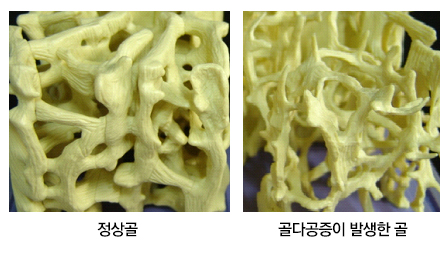
Bone is a constantly changing organ throughout life. About 10% of bone is replaced each year, and over 10 years, all the bones in the body are replaced with new bone. Bone density is highest in the 20s and 30s, then gradually decreases. In women, bone density drops significantly during the first 5 years after menopause. Osteoporosis is a condition where bone mass and density decrease, increasing fracture risk. What makes osteoporosis dangerous is precisely this increased fracture risk. Even a minor fall, or even a sneeze or bump against furniture, can result in a broken bone.
How Serious is Osteoporosis if Left Untreated?
The domestic patient population with osteoporosis is estimated at over 2.5 million, and approximately 50,000 new fracture patients develop each year due to osteoporosis. In women aged 65 and older, fractures occur in 1 out of 2 women, and in men, fractures occur in 1 out of 5 men. In patients who experience spinal or hip fractures, the mortality rate increases by more than 8 times compared to the general population.
Based on 100 women aged 50 and older in Korea, approximately 3 die from hip fractures—a mortality rate equal to that of breast cancer and about 4 times higher than endometrial cancer.
Is Regular Screening for Osteoporosis Necessary?
Women after menopause should undergo osteoporosis screening annually. Even before menopause, regular screening is recommended for those with particularly high osteoporosis risk: lean women whose mothers have osteoporosis, smokers, sedentary individuals, excessive alcohol drinkers, people who don't consume milk, those with early menopause, people taking corticosteroid medications, those bedridden for long periods, and those with hyperthyroidism or hyperparathyroidism. At the hospital, various osteoporosis tests can be performed, including simple X-ray imaging, and testing takes only a few minutes.
What is Bone Mineral Density?
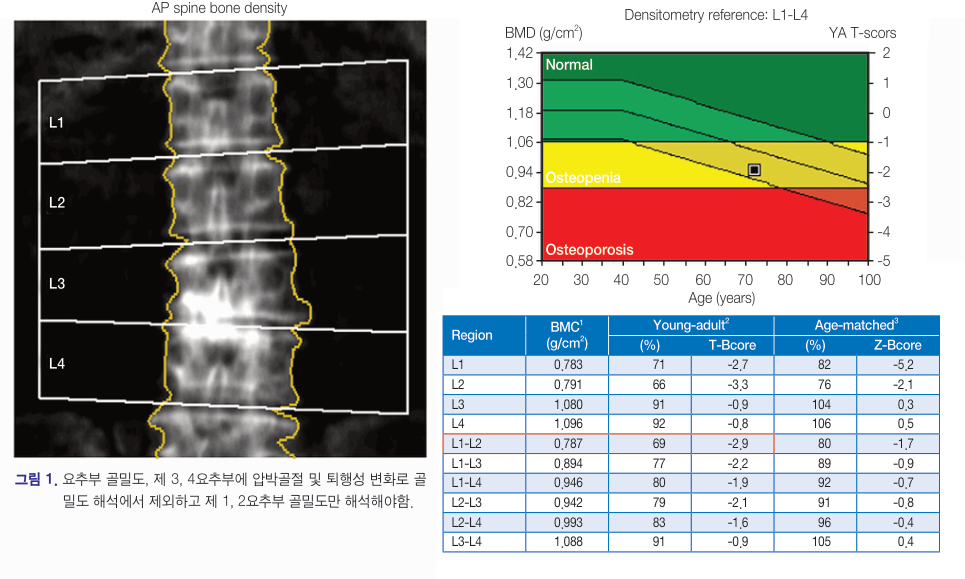
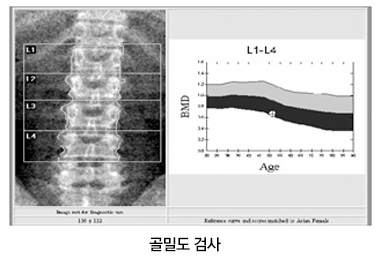
Bone mineral density is the most useful criterion for diagnosing osteoporosis and helps determine treatment plans and evaluate treatment response. Measuring bone mineral density predicts fracture risk to enable prevention and treatment. The World Health Organization expresses bone mineral density as a measurement compared to normal adults, displayed as the T-score. A T-score between -1.0 and -2.5 is called osteopenia, while a T-score below -2.5 is diagnosed as osteoporosis.
Who Should Have Bone Mineral Density Testing?
All women aged 65 and older, and women under 65 with risk factors for osteoporosis should have bone density testing. These risk factors include early menopause, ovariectomy, endocrine disorders such as hyperthyroidism, kidney failure, or diabetes, prolonged use of corticosteroid medications, long-term nutritional deficiency from gastrointestinal disease, sedentary lifestyle or prolonged bed rest, excessive smoking or alcohol use. Osteoporosis screening is essential for these individuals.
Furthermore, screening is recommended for those with a history of fractures from minor trauma or family history of osteoporosis. Male osteoporosis patients have been increasing recently, with risk factors including smoking, alcohol use, and decreased testosterone. Therefore, men with these risk factors should also definitely undergo bone mineral density testing.
Is Osteoporosis Only Found in Women?
Female osteoporosis patients outnumber males by approximately 6 to 1. The reason is that women have thinner and weaker skeletal structures than men, and bone loss accelerates after menopause, making osteoporosis much more common in women. Estrogen, a female hormone secreted by the ovaries, is very important for maintaining bone strength, but after menopause it is no longer produced, leading to increased bone loss. A 16.7% decrease in bone mineral density has been reported during the 10 years after menopause, so osteoporosis typically forms by 6-7 years post-menopause.
How Does Osteoporosis Differ from Osteoarthritis, Another Common Condition in Older Adults?
Osteoarthritis is a condition where joint cartilage wears away, resulting in localized degenerative changes. This causes joint pain and movement dysfunction, eventually leading to loss of joint function. Many patients incorrectly believe these symptoms are caused by osteoporosis—weakened bones. However, osteoporosis produces no distinctive symptoms until a fracture occurs. Therefore, if pain develops after excessive joint movement or in the evening, improves with rest, and affects weight-bearing joints (especially the knee), osteoarthritis should be suspected.
What Is Essential for Building Strong Bones?
Young women often diet, but even when consuming low-calorie meals, balanced nutrition is important—including adequate calcium, phosphorus, and vitamins. To achieve this, sufficient milk, fruits, and vegetables rich in calcium should be consumed. If concerned about calories, low-fat milk is a good alternative. In particular, smoking cessation and alcohol avoidance are absolutely essential for osteoporosis prevention.
Maintaining adequate vitamin D levels in the body is also important. Approximately 30% of Korean adults have vitamin D deficiency. Among postmenopausal women, as many as 90% are exposed to vitamin D deficiency, so adequate vitamin D supply is necessary. Insufficient vitamin D reduces calcium reaching the bones, which can lead to osteoporosis.
Exercise provides continuous stress on the bones, and bone responds to this stress by maximizing bone mineral density as a defense mechanism. Weight-bearing outdoor exercises such as walking and cycling allow the body to produce vitamin D from sunlight, which aids calcium and phosphorus absorption and strengthens bones further.
However, excessive exercise is unnecessary; regular exercise is more important. Particularly, weight-bearing exercises such as walking, climbing stairs, and jogging are beneficial for osteoporosis prevention.
Nutritional Foods to Prevent Porous Bones
Calcium is the most easily deficient nutrient in modern diets. Milk contains high calcium content and also contains lactose and casein, which aid calcium absorption. Those with lactose intolerance should supplement with supplements if dairy intake is insufficient. Additionally, calcium is abundant in fish, seaweed, tofu, and dark green vegetables. Calcium absorption increases when consumed with low-fat foods and protein.
▶ SpineTube | Does drinking milk help with osteoporosis? ↗Milk and dairy products, dark leafy green vegetables like spinach, tofu, anchovies, cheese, yogurt, eggs, oysters, clams, and dark leafy vegetables contain abundant calcium.
Besides calcium, protein, vitamin D (from fatty fish like salmon and mackerel, egg yolks, mushrooms), and phosphorus and other nutrients strengthen bones. It is important to consume all necessary nutrients through balanced meals three times daily. The recommended calcium intake for adults is 800-1,000 mg daily, and for adolescents during growth, postmenopausal women, and elderly persons, 1,500 mg is recommended. If adequate calcium cannot be obtained through diet alone, calcium supplementation is advisable.
Vitamin D helps the intestines absorb calcium and phosphorus, promotes mineralization to increase bone mineral density, and aids neuromuscular control to reduce fractures. Vitamin D is produced in the skin through sun exposure from outdoor activities. However, when sun exposure is limited, dietary intake becomes important—milk and soy milk are good sources.
How Does Exercise Prevent Osteoporosis?
Bones increase in strength when subjected to appropriate loading. Exercise is known to increase bone mineral density. Combining weight-bearing exercises and strength-building exercises is ideal. Weight-bearing exercises such as walking, climbing stairs, and jogging are excellent methods for osteoporosis prevention. Movement should be more demanding than usual activity, applying short, strong weight-bearing forces on bones. Applying appropriate exercise stress for about 30 minutes daily is effective.
Strength training: dumbbells, push-ups, knee extensions—2 times weekly, 50 minutes per session
1. Warm-up - stretching, slow walking
2. Resistance exercises - dumbbell arm, chest, and shoulder exercises
3. Aerobic exercise - walking at 4 km/h pace, cycling
4. Cool-down - stretching, slow walking
What Are the Treatment Options for Osteoporosis?
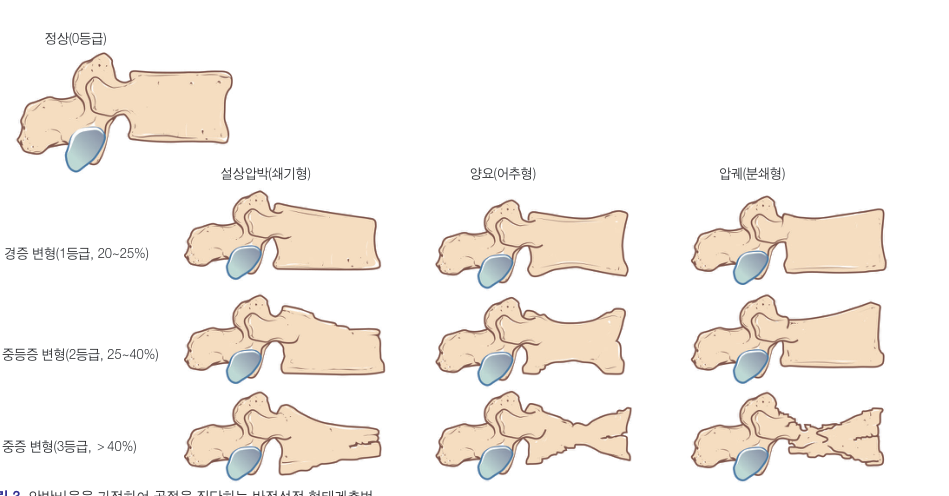
Treatment can be divided into medical therapy and surgical therapy. Medical treatment includes pain relievers to control acute pain after fracture and complementary therapy for osteoporosis treatment, consistent with general osteoporosis management. Surgical treatment aims to remove spinal instability, decompress the spinal cord, and correct deformity. Surgery is performed for painful severe kyphotic deformity, progressive paralysis from posterior vertebral body bone fragment compression, and when vertebral body necrosis or instability has developed.
Medical Therapy
1) Bisphosphonates
Oral medications such as alendronate, risedronate, and ibandronate are commonly used, and intravenous forms include ibandronate and zoledronic acid. Oral forms demonstrate considerable effectiveness, but recently, due to side effects from long-term use and gastrointestinal issues, intravenous medications are increasingly used. Intravenous therapy is particularly valuable for elderly patients with comorbidities like hypertension and diabetes requiring multiple medications. While oral forms absorb only about 0.6-1%, intravenous forms show 100% bioavailability and have virtually no gastrointestinal side effects. According to 2005 IOF research on continued bisphosphonate use, the main problems reducing compliance are fasting-state administration and maintaining an upright posture after dosing. Commonly reported side effects include gastrointestinal upset, cardiac abnormalities, jaw bone necrosis, and atypical femoral fractures. Jaw bone necrosis, a potential concern with long-term osteoporosis treatment, is reported at 0.05-0.07% in Korea, but in patients on long-term therapy over 3 years undergoing major bone-exposing surgery or treatment, discontinuation 3 months before treatment is recommended. Although atypical femoral fractures have relatively low frequency, when they occur, clinical outcomes are severe. Patients on long-term therapy with persistent unexplained thigh pain should seek specialized orthopedic evaluation for safety.
2) Selective Estrogen Receptor Modulator (SERM)
Selective estrogen receptor modulators (SERM) are known to be effective in improving bone quality rather than bone mineral density. Due to ongoing controversy about various side effects from long-term bisphosphonate use, SERM use has increased recently. While approved indications exist for use in osteopenic patients, insurance coverage in Korea is not available for use in osteopenia patients.
3) Parathyroid Hormone Therapy
Parathyroid hormone therapy is a medication that helps build new bone. Its drawback is cost, as it is not covered by insurance, and some patients occasionally report nausea or dizziness. In the past this was the only bone-forming medication available, but more recently another bone-forming agent, romosozumab, has also come into use.
4) Denosumab
Denosumab is an injection that blocks the formation of the cells that break down bone. It is given under the skin once every 6 months. It causes no gastrointestinal upset and can be used relatively safely in people with reduced kidney function, so it is widely used in elderly patients and in those at high risk of fracture. Unlike bisphosphonates, however, it is not given with a drug holiday, and stopping it on your own can cause bone mineral density to fall rapidly and fracture risk to rise again, so it should never be discontinued without consulting your doctor.
Surgical Treatment
1) Is Surgery Always Necessary?
Most patients have no neurological symptoms and instability is rare, so conservative treatment is performed. However, when serious complications develop, surgical treatment is appropriate. Many patients consider only major surgery and overlook this option, but recently, treatment methods have been introduced that can treat the condition simply if diagnosed early in the disease course.
2) What Types of Surgical Procedures Are Available?
Vertebroplasty, balloon kyphoplasty, and fusion are available. Vertebroplasty is a surgical procedure where bone substitute material is inserted into and reinforces the fractured vertebral body to reduce pain. It has the advantage of being cost-effective and allowing rehabilitation quickly. However, this procedure is not suitable for all patients; early vertebral compression fractures are ideal candidates. If the timing is missed and the disease becomes advanced, nerve compression may be present, requiring extreme caution when performing this procedure. Cement leakage complications from this procedure can cause spinal cord nerve paralysis, pulmonary cement embolism leading to death, and other serious complications, so favoring only the most advanced treatments is not advisable.
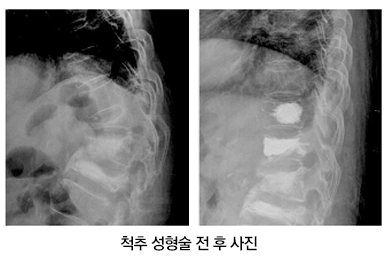
Balloon kyphoplasty is a procedure where a balloon is inserted into the fractured vertebra and expanded to restore the compressed fracture site, then cement is injected to fill the space.
Fusion is performed when severe compression deformity exists, using bone grafting combined with fusion. Particularly in recent years, with advances in medical technology, the scope of procedures has expanded even for high-risk patients who previously could not undergo surgical treatment.
Medical review: Spine Osteoporosis Research Society · Provided by the Korean Society of Spine Surgery