Do you know someone who keeps going from hospital to hospital because their legs give way and they cannot walk properly? Some people find their hands growing weak and clumsy, so that they drop chopsticks and other things they are holding and struggle to button a shirt, and they say they cannot walk well because their balance is off. At first this is often mistaken for a stroke, and they visit one clinic after another while the symptoms keep getting worse. Here we explain cervical myelopathy — a name that is still relatively unfamiliar, though the number of patients keeps rising as the population ages.
What is 'cervical myelopathy'?
Cervical myelopathy refers to the symptoms produced by compression of the spinal cord, which can arise from a number of causes. The difference from an ordinary cervical disc herniation (cervical radiculopathy) is that a disc herniation compresses the peripheral nerve running from the neck to the hand, whereas cervical myelopathy compresses the central nervous tissue in the middle of the cervical spine — though myelopathy and radiculopathy sometimes occur together. Put simply, it is the difference between pressing on the trunk of a tree and pressing on one of its branches. Because it is the central nervous tissue that is being compressed, physical therapy and medication rarely bring much improvement, and a physical blow can sometimes trigger severe paralysis below the neck; both points set it apart from a cervical disc herniation. Besides external compression from a central soft disc herniation or a centrally placed bone spur pressing on the spinal cord, cervical myelopathy can also involve a congenitally narrow front-to-back diameter of the spinal canal, dynamic compression of the cord, dynamic changes in the internal structure of the cord, and abnormal blood flow to the cord.
What problems can develop if I have 'cervical myelopathy'?
Cervical myelopathy occurs mainly in men over the age of 50, and the symptoms usually begin slowly and develop over a long period. Its two common early symptoms are weakness, clumsiness, and altered sensation in the hands, together with difficulty walking from weakness in the legs. Pain is not a common symptom. Patients particularly lose fine control of the hands, so they often say they have trouble using chopsticks, drop things easily, and cannot fasten shirt buttons. As myelopathy progresses, bowel and bladder problems may follow.
- These impairments usually progress slowly, but in a patient whose spinal canal is already narrow, a physical blow
- such as a rear-end car accident or a fall in which the head is struck,
- or even an impact that would leave most people with nothing worse than a sore muscle, can make the paralysis worsen abruptly.
How can I tell if I have 'cervical myelopathy'?
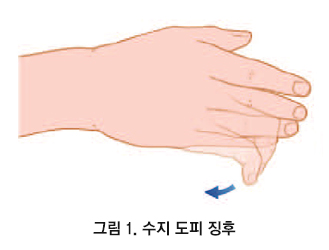
Nothing matters more in diagnosing cervical myelopathy than a close history and a careful neurological examination. The characteristic finding is the myelopathic hand: the patient cannot open and close a fist more than 20 times in 10 seconds (the grip and release test), or, when the fingers are held out straight, the ring and little fingers drift apart within 30 seconds — the finger escape sign (Figure 1). When myelopathy is suspected, plain radiographs are taken in anteroposterior, lateral, and dynamic views to look for loss of disc height and bone spurs inside the spinal canal, and to check cervical alignment. CT or MRI should be obtained for an accurate diagnosis; each has its own strengths and limitations.
MRI in particular shows both the direct cause of the compression and the condition of the spinal cord itself, which makes it essential for diagnosing myelopathy and planning surgery. Electromyography can help separate cervical radiculopathy from peripheral nerve disorders, but its sensitivity is low.
What is the natural history of 'cervical myelopathy'?
Cervical myelopathy is known to follow a different course from an ordinary cervical disc herniation. It is a progressive disorder that responds poorly to conservative treatment and almost never resolves on its own; most patients progress through repeated flare-ups of symptoms, and some studies report that in a subset the symptoms progress steadily or worsen suddenly. Other studies, by contrast, have described cervical myelopathy as a non-progressive disorder that simply persists for a long time.
What diseases present with symptoms similar to 'cervical myelopathy'?
Conditions that look similar include cerebrovascular disease, tumors of the brain and spinal cord, multiple sclerosis (a chronic neuroimmune disease of the central nervous system), syringomyelia (a fluid-filled cavity forming inside the spinal cord), and amyotrophic lateral sclerosis (ALS, commonly known as Lou Gehrig's disease). Because the possibilities are so varied, proper testing and a specialist's diagnosis are needed.
How should 'cervical myelopathy' be treated?
The Cervical Spine Research Society in the United States has reported that cervical myelopathy has a poor prognosis when treated without surgery. Most cases progress slowly, with symptoms flaring and easing in turn, and conservative treatment offers little prospect of improvement, so early surgery is called for once daily life is affected.
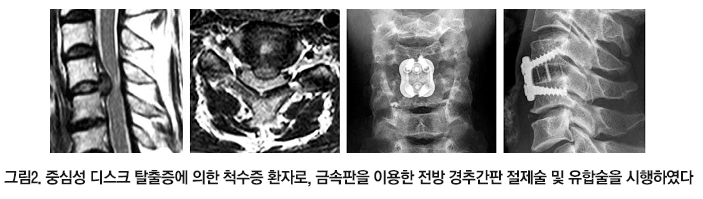
Surgery for cervical myelopathy divides broadly into anterior and posterior approaches. The anterior approach is anterior decompression and fusion: the disc or the vertebral body is removed, bone from the pelvis or an artificial bone-fusion material is placed between the cervical vertebrae, and the segment is secured with a metal plate. Its advantage is that the structures compressing the cord, which usually lie in front, can be removed directly. It does carry a risk of dural and nerve injury, however, and when three or more segments are operated on, complications such as non-union become more frequent; fusion has also been suggested to bring on degeneration of the adjacent segments (adjacent level degeneration). The anterior cervical approach is therefore preferred when the compression is limited to one or two segments, or when radicular symptoms predominate (Figure 2).
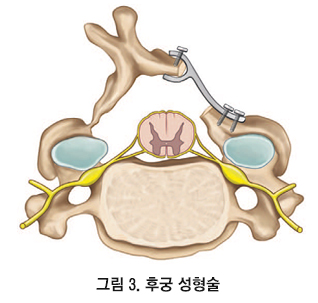
When, on the other hand, three or more segments are compressed, when congenital or developmental spinal stenosis is also present, or when cord symptoms rather than radicular symptoms predominate, a posterior approach is generally used, with either laminoplasty or laminectomy. Laminoplasty is currently preferred, because it produces less of the cervical kyphotic deformity and peridural scarring that can follow laminectomy (Figure 3).
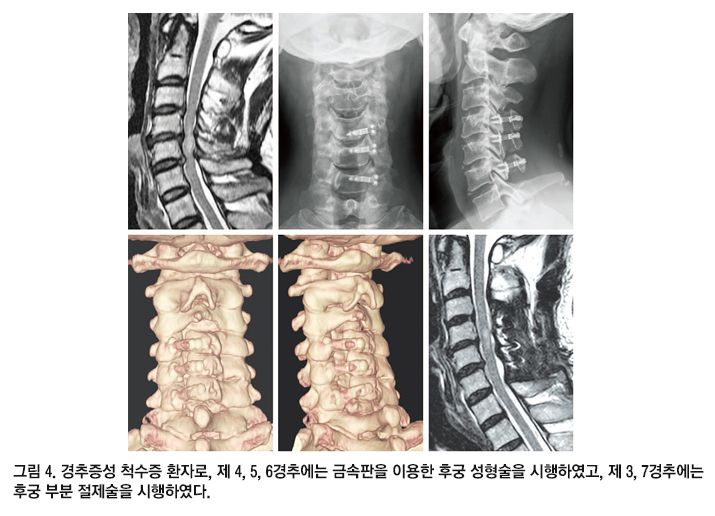
In some cases, laminoplasty or laminectomy is combined with posterior fusion (Figure 4).
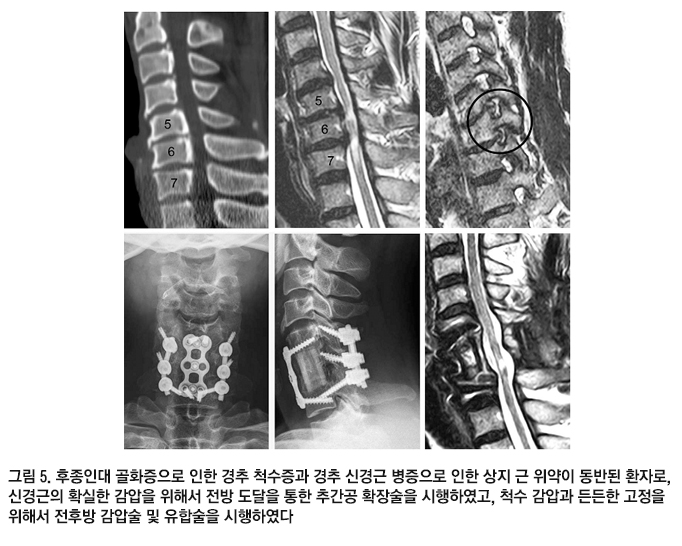
Finally, when radiculopathy and myelopathy occur together, combined anterior and posterior surgery may be needed — the anterior operation to decompress the nerve root and the posterior operation to decompress the spinal cord (Figure 5).
Medical review: Cervical Spine Research Society · Provided by the Korean Society of Spine Surgery